The Unknowable Truth
Navigating an uncertain world.
Seeing is believing. We want to think that’s true, but reality isn’t so straightforward. We tell ourselves that what we see, hear, and experience is the truth and that our perception faithfully represents reality, but physics, psychology, and philosophy suggest otherwise. Our mind doesn’t passively receive reality—it reconstructs it, distorts it, and outright fabricates it. What if our perception is just an evolved interface, a functional illusion designed more for survival than for accuracy? What if the very truths we cling to—our institutions and beliefs—are just shared fictions we’ve all agreed to participate in? It would mean the truth is unknowable, and we live in a disturbingly uncertain world.
Just the same, we have to navigate that world and make consequential decisions with imperfect knowledge. In such a world, if we develop a nuanced appreciation for the limits of our understanding, recognize the gaps in our perception, question our deepest assumptions, and refine our mental models, we can at least make better decisions in the face of the Unknowable Truth. Lucky for us, there are some great thinkers who have already started down this winding road.
In Nexus: A Brief History of Information Networks from the Stone Age to AI, Yuval Noah Harari recognizes three categories of truths (he calls them “realities”): objective realities, subjective realities, and intersubjective realities. The laws of physics, such as gravity, represent an objective reality that impacts everyone. That funny feeling you get in your stomach when gravity takes hold during the big drop on a roller coaster is a subjective reality, meaning it is true to you only in the context of your personal experience. Then there are the mysterious intersubjective realities; these are invented by people, and they are true only because enough people collectively agree they are true—think of language, justice, and money.
French sociologist and philosopher Jean Baudrillard had another term for intersubjective truths; he called them “hyperrealities” or, more obtusely, “simulacra.” In his thin but painfully difficult-to-read book Simulacra and Simulation, Baudrillard proposes that “The simulacrum is never that which conceals the truth—it is the truth which conceals that there is none. The simulacrum is true.” If you spend thirty years trying to untangle that riddle, as I have, you might conclude that the human mind can create abstract models (simulations) of the reality it perceives and, it can alter those abstractions, creating new models for things that don’t yet exist. It gives the person attached to that mind a mental blueprint for bringing novel concepts to life. In the process, something new is realized—something that has no reference to the natural world. A person can imagine a house and then build that house. The house is real.
The enigmatic cognitive psychologist Donald Hoffman believes that all reality, as we perceive it, is a construct of our minds. If you believe in evolution, then it tracks that humans have evolved to perceive the world in the way best suited for our survival—not necessarily in a way that is the most accurate. Multiple experiments with evolutionary game theory support this hypothesis. It’s his “fitness beats truth” theorem. In The Case Against Reality: Why Evolution Hid the Truth from Our Eyes, Hoffman suggests the reality we perceive is analogous to the icon of a file on your computer screen. The file is not really there, but the icon makes it easier for us to interact with the incomprehensible binary code running on the circuitry within our computer. The icon is a useful misrepresentation of the reality that lurks below.
Author and philosophy professor David Livingstone Smith also suggests that evolution has distorted how humans perceive reality. In Why We Lie: The Evolutionary Roots of Deception and the Unconscious Mind, Smith contends that humans learned to lie because deception gave them an advantage over competitors. To combat deception, humans also evolved to detect lies by interpreting difficult-to-hide microexpressions and other tells. A professional poker player might admit that it is difficult to hide those microexpressions—that’s why some wear hats and sunglasses. To get around this problem, evolution gave us the diabolic ability to convince ourselves that our own lies are true, allowing us to more easily deceive others. The trick only works when we do it subconsciously, which suggests we’re all deluding ourselves to get what we want, and we don’t even know we’re doing it.
Even when our brain isn’t trying to delude us, it still makes subconscious errors in how it perceives and understands the world. In Thinking Fast and Slow, psychologist Dr. Daniel Kahneman asserts that part of our mind, which he calls “System 1,” is constantly creating “a coherent interpretation of what’s going on in our world at any instant.” That interpretation, however, is prone to bias and is often over-simplified using mental shortcuts and assumptions that psychologists call “heuristics.” Kahneman says this contributes to “a puzzling limitation of our mind: our excessive confidence in what we believe we know, and our apparent inability to acknowledge the full extent of our ignorance and the uncertainty of the world we live in.”
These “puzzling limitations of our mind” become very important when we have consequential decisions to make. Kahneman’s life’s work was studying prospect theory, which describes how people make decisions under uncertainty and risk. I’d argue that most of the decisions we make involve some risk, even if the risk is small. I’d also argue that we make all decisions under some degree of uncertainty—especially if we believe Kahneman’s contention that our mind is plagued with biases and heuristics, or if we buy Smith’s argument that we’re all perpetually deluding ourselves. Or if we entertain Hoffman’s hypothesis that our perception of the world is an evolutionary illusion. Or if we acknowledge that we live in a befuddling confluence of Baudrillard’s hyperrealities and Harari’s intersubjective realities.
With all this confusion and uncertainty, how do we ever make important decisions with any confidence at all? Here’s how: We take time to build a better mental model and we learn to live with some uncertainty. Kahneman’s work suggests that when the stakes are high, a more evolved part of our brain, System 2, takes over and tries to build a better map of reality in an attempt to override the subconscious biases and heuristics of System 1. Sadly, however, no matter how hard we try, our map of the world will never be a perfect facsimile; there will always be gaps between our understanding of reality and reality itself—the Unknowable Truth.
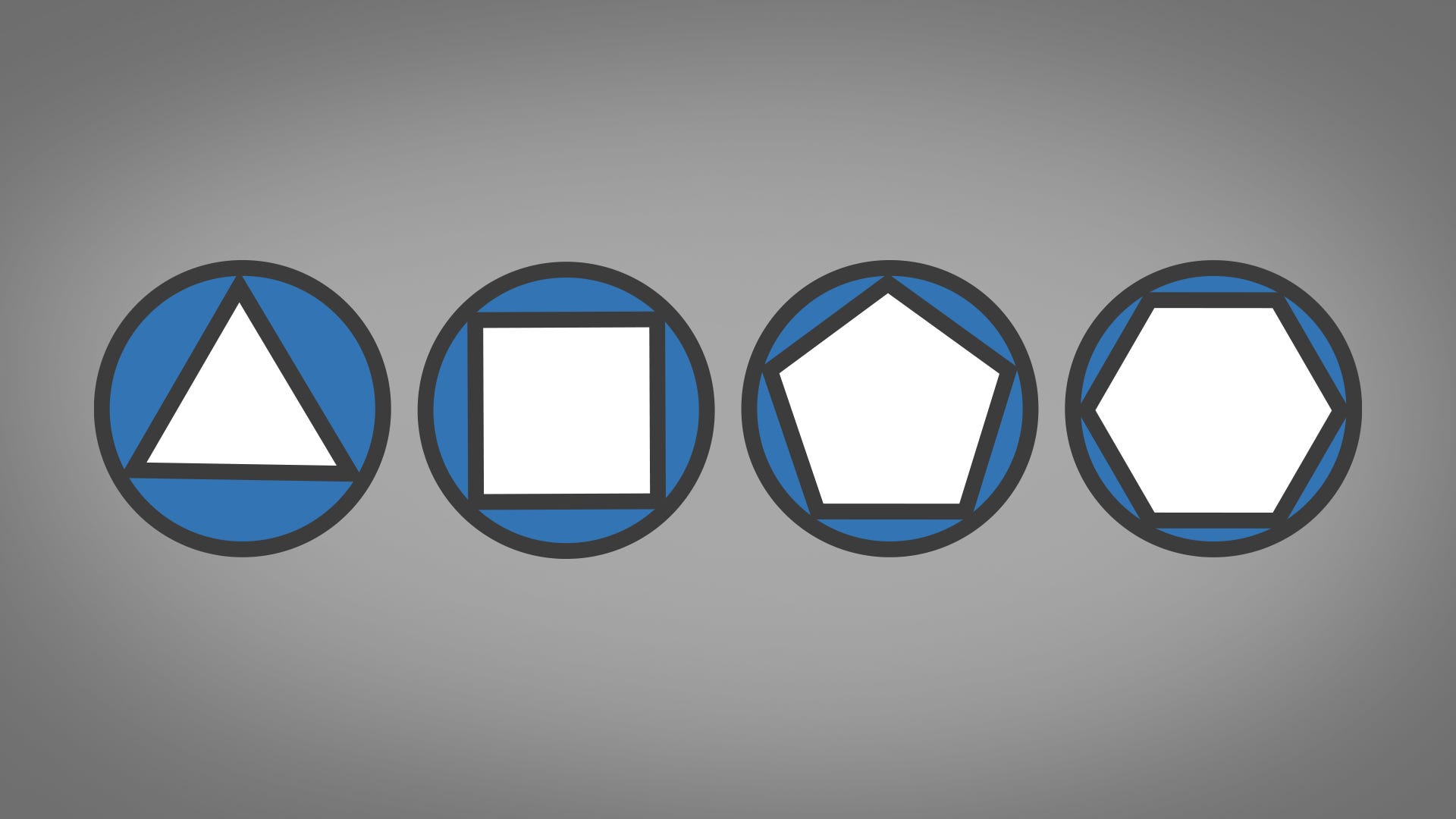
In his book The Black Swan: The Impact of the Highly Improbable, polymath Nassim Nicholas Taleb describes these gaps as “The Platonic Fold.” Without going deep into Platonism, The Platonic Fold, Taleb writes, is “the explosive boundary … where the gap between what you know and what you think you know becomes dangerously wide.” It’s where “our representation of reality ceases to apply.” To picture the Platonic Fold, I like to imagine a circle that inscribes an equilateral polygon. The circle represents reality; the polygon represents our abstract model of it. The gaps between the polygon’s sides and the circle represent the Platonic Fold—the space where our understanding fails to capture reality. A triangle leaves broad gaps. A square leaves less. A pentagon, less still. The more sides we add, the smaller the gaps become—but no matter how many we add, a polygon can never become a perfect circle. There will always be a space between our cognitive model and reality itself.
If we dedicate ourselves to the pursuit of the truth, and if we stop and override our flawed System 1 mind when we make consequential decisions, then we might build a more useful map of reality to rely on—and reduce the chances of an unexpected negative outcome. Nonetheless, we must not become overconfident about the accuracy of our map, because no matter how good it is, there will always be gaps—Platonic Folds—where catastrophic outlier events may befall us.
When navigating uncertainty, there is a benefit to recognizing when you are in a Platonic Fold. One way to do this is to focus on the results of your actions. When your decisions produce unexpected outcomes, there is a good chance your model is misaligned with reality. You then have an opportunity to question your assumptions, realign your model, make different choices, and try again. That type of experimentation forms the foundation of the scientific method, by the way. By identifying and eliminating everything that doesn’t work, we’re left with something closer to the truth.
The Unknowable Truth is an invitation to sharpen your understanding of reality—however imperfect that understanding may be—and to learn to accept uncertainty in your life. To navigate uncertainty, we must examine the foundations of what we think we know. The Unknowable Truth explores these ideas in depth, uncovering their presence in books, music, film, politics, sports, games, philosophy, science, and religion. The more we search, the more we find. The more we find, the more we understand. The more we understand, the more accurately we can build our model of the world, allowing us to make better decisions. In future posts, we’ll define the key concepts that shape our perception of reality and explore how they influence our choices. By refining our models and embracing the limits of our understanding, we can get closer to the Unknowable Truth—and, in the process, live more genuine, meaningful lives.