Does Everyone Have Their Socks?
The bounded rationality of a Korean War veteran.
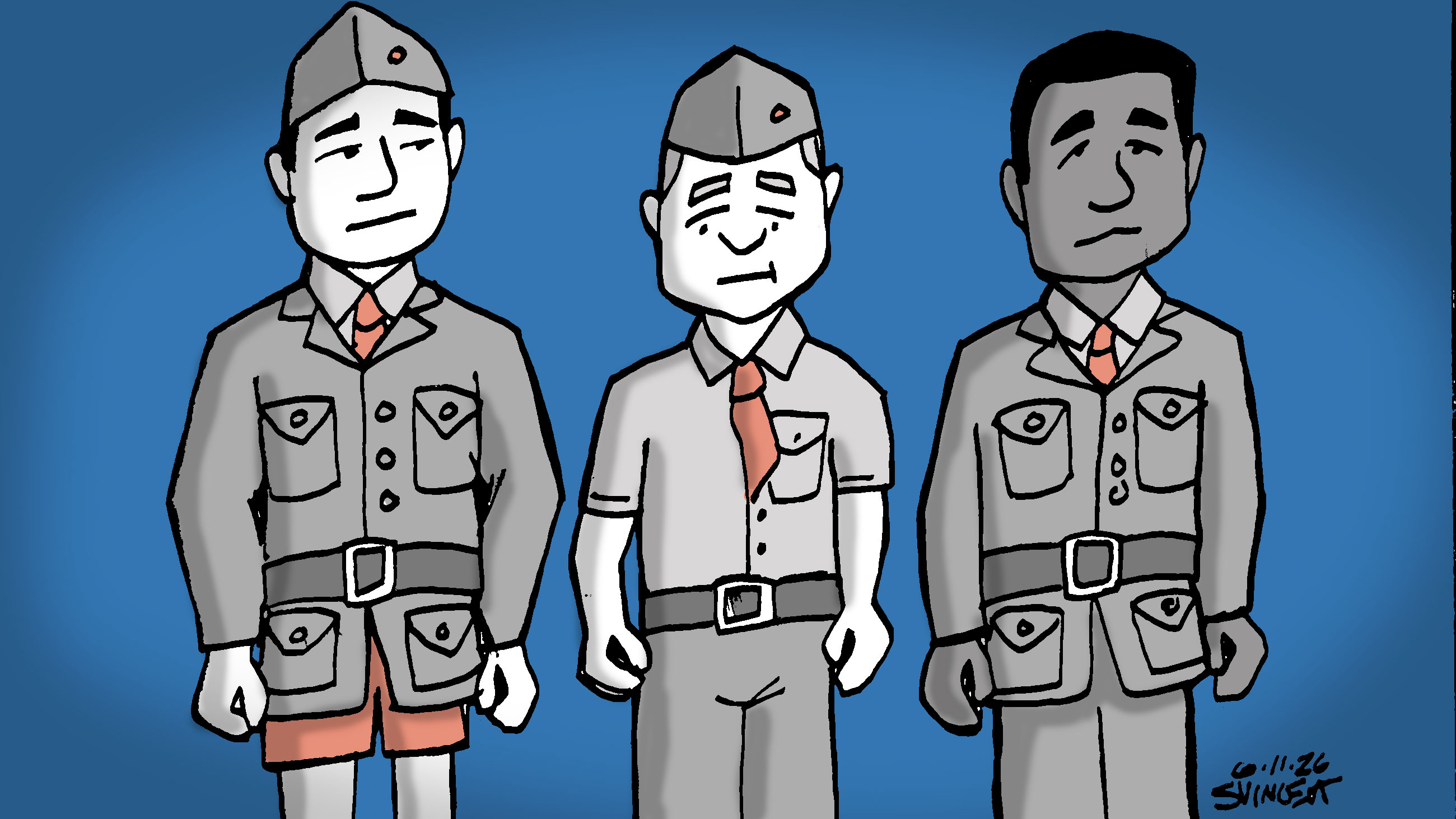
Decades ago, I met an old veteran who told me he’d been drafted to fight the Korean War. He recalled how he and a company of other draftees—and presumably some poor souls who joined of their own volition—lined up before supply sergeants on the first day of boot camp. The sergeants issued the elements of a private’s basic training uniform: shirts and shoes, socks and skivvies, belts and boots. One garment at a time, the sergeants called out sizes while the recruits waited and listened for their match. After minutes of wrangling, the sergeants called out, “Does everyone have their trousers?” or “Does everyone have their boots?” If they received no responses, they moved on to the next garment.
At the end of the ordeal, one private raised his hand and said he never got his socks. Another claimed he didn’t get a belt. Several men slipped through the cracks. The old veteran told me that he never understood how so many people managed to thwart the rigor of the supply sergeants’ thorough distribution process. I understood his point, but I considered how I would feel on my first day of boot camp, after being conscripted and torn away from my life, about to be shipped across an ocean to fight a foreign war. I suspected I’d be fearful and distracted.
I imagine that at least one private left a girl at home who he hoped to marry, and as sergeants called out sock sizes, he became lost in the speculation that she wouldn’t wait for him. Another, perhaps, felt concern over his family’s struggling business, and while others listened for their belt sizes, he focused on his regret for abandoning his ailing father when he needed him most. The fear of being maimed or killed in combat, I suspect, consumed most of the men. I thought of a dozen reasons why some kid, right out of high school—or perhaps plucked from his family farm, never having graduated—might have been distracted as a supply sergeant barked out boot sizes. Each soldier-in-training had a different level of education, divergent life experiences, and varying personal priorities competing for their attention.
Psychologist Herbert Simon coined the term bounded rationality to describe the idea that different people have diverse abilities to receive and process information. More formally, the principles of bounded rationality suggest that the rationality of our actions is limited by information asymmetry, cognitive limitations, and time pressures. Before Simon, economists assumed people made rational decisions based upon all the information available to them. “Broadly stated,” Simon writes, “the task is to replace the global rationality of economic man with the kind of behavior that is compatible with the access to information and the computational capacities that one actually possessed by organisms, including man, in the kind of environment in which such an organism exists.” In the context of bounded rationality, it’s not surprising that some of the men in a company of soldiers will mishear or misunderstand instructions; it is, in fact, practically inevitable.
The old veteran I knew possessed an uncommon intelligence. He proved smart enough to avoid combat in Korea, instead serving in logistics, an occupation that found him accompanying cargo on transport planes, flying regular routes between American bases in Korea, Japan, and Guam. People in each of these locations traded with a different currency—the won, the yen, and the American dollar. Each day, banks in each region would observe new published exchange rates. Because he moved so often and so quickly, the old veteran often arrived at a new place before banks had adopted the new exchange rate. He learned to exploit the information asymmetry, swapping currencies everywhere he went to make a profit—a time-honored practice known as arbitrage. He came home from Korea with a small fortune.
I met the old veteran in the 1990s when I briefly sang with a barbershop chorus. He sang baritone, and I sang tenor—not because I was particularly good at it, but because most of the old men in the group lacked the physical ability to hit those high notes (I was the youngest by about 40 years). At times, the old veteran became frustrated when other old men in the chorus had difficulty following the director’s instructions. Many couldn’t hear very well, and some exhibited symptoms of dementia. The whole organization ran with the efficiency of The Muppet Show.
When a rehearsal began to fall apart, the old veteran would remember his experience in the army, and he’d tell me about his first day of boot camp, and the trouble of privates claiming their socks. He told me that story on at least half a dozen occasions, unaware, I believe, that he had ever told me the story before. He also repeatedly called me “Shane” until I finally reminded him my name is “Shawn.” Afterwards, he called me “Scott.” In his old age, the veteran faced increasing cognitive limitations, compounded by the fact that he didn’t seem aware that he faced any cognitive decline at all.