Out of Whole Cloth
The glorious fabrication of America.
I was a bicentennial baby, born in 1976, during the narrow window between Gerald Ford’s electoral defeat and the ascension of President Jimmy Carter. Just a little over two years after Richard Nixon’s ignominious resignation, and a year and a half beyond the humiliating fall of Saigon, with lingering inflation and a global oil shortage, America, I’ve been told, had lost the sense of greatness it enjoyed in the years following the end of World War II. Disillusioned and depressed, the nation nonetheless rallied and honored a kind of stale patriotism to commemorate its 200th birthday.
That is, if you consider July 4, 1776, and the signing of the Declaration of Independence, as the moment of the nation’s birth. I’ve come to think of Independence Day more as the moment of conception, followed by a five-year gestation and a bloody labor that nearly killed mother and child. The fighting in the Revolutionary War didn’t cease until 1781, and the broader international diplomatic community didn’t officially recognize our fledgling nation until the Treaty of Paris in 1783. Another four years passed until the drafting of the Constitution. Ratification took nine months more, bringing us to the summer of 1788. George Washington didn’t assume the presidency until April of 1789—almost 13 years after the signing of the founding document.
As a legal instrument, the Declaration of Independence rests on the flimsiest of foundations: “We hold these truths to be self-evident,” the document proclaims. I cannot imagine the stodgy attorney John Adams proffering evidence in court without laying a proper foundation—yet he gladly adopted Jefferson’s loose language as justification for radical treason against King George III. The concept of “unalienable rights” and the idea that governments derive “their power from the consent of the governed” had only recently emerged from the Enlightenment and remained untested at scale until the American experiment. As such, proclaiming those new and novel ideas as “self-evident” must have seemed comically audacious and naive to the monarchists of the time.
I suppose, however, that anything can become self-evident if enough people believe in it. In 1776, the delegates from thirteen colonial governments agreed on the idea of a new, independent nation. In 1778, France, sensing an opportunity to beguile her old enemy England, endorsed the new nation by signing the Treaty of Amity and Commerce. When John Adams—who King George III once branded an unpardonable traitor, presumably marked for death—appeared before the sovereign in the official role of Minister Plenipotentiary in 1785, it had become, perhaps, self-evident that the United States, indeed, existed on Earth as a nation among nations.
The idea of America, of course, predates the signing of the Declaration of Independence. A Grand Union flag displaying the “Continental Colors” began flying above the thirteen colonies in 1775, featuring the now-familiar alternating red and white bars, but with a Union Jack occupying the canton. A canton, I’ve just learned, is what they call the rectangle in the top left corner of a flag. Colonists who looked upon the Grand Union flag might recognize the link to Great Britain—but they might also gain a growing sense of the colonies as a distinct, united entity. The flag propagated the concept of the colonies as separate from the mother country.
After the Declaration of Independence, the colonists dropped the Union Jack from the canton, replacing it with a blue field bearing thirteen stars, which represented a “new constellation,” as stated in the Flag Act of 1777. The act didn’t specify the dimensions of the flag or how to arrange the stars, resulting in many variations. Despite the non-standard design, the distinctive banner adorned ships at sea and accompanied settlers venturing into the interior of the continent. Wherever the flag went, it brought with it the idea of the new nation. Recognition of the physical flag helped reinforce diplomatic recognition of the newly conceived country it symbolized.
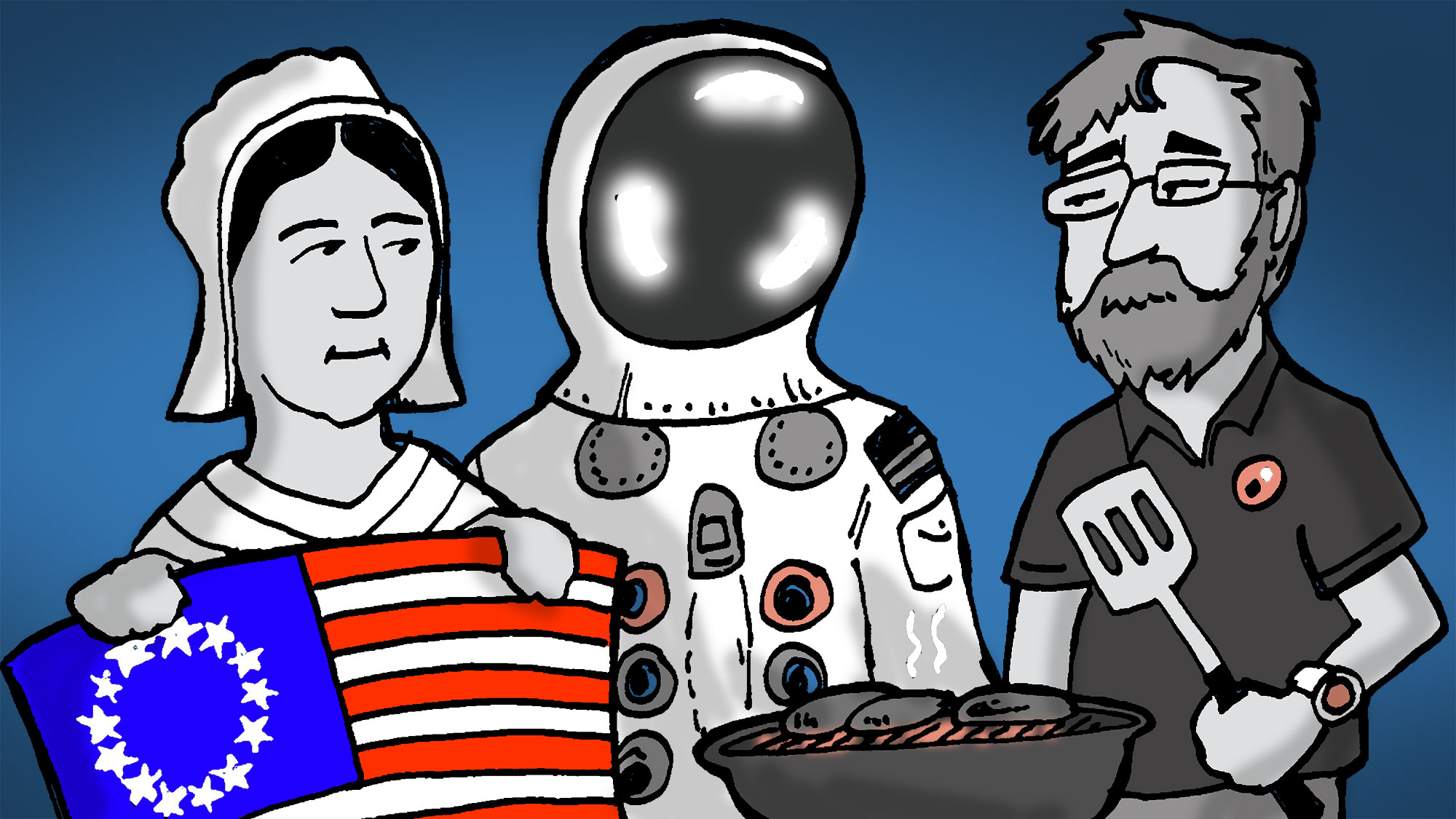
No one is really sure who designed the American flag. Most of our grade school teachers told us that a Philadelphia seamstress named Betsy Ross created the stars and stripes. While she sewed many flags for the Continental Army during the Revolutionary War, historians largely agree that the Betsy Ross creation story is a myth. Instead, historians look to Francis Hopkinson, a signer of the Declaration of Independence, who submitted a bill to the Continental Congress requesting payment for the design. If you want official credit for an idea, submit an invoice to an established authority. If you want to be known for something, come up with a good story.
As the country evolved, so did the design of the American Flag. In 1795, after Vermont and Kentucky joined the union, Congress added two stripes and two stars. It’s the flag with the fifteen stripes that flew over Fort McHenry during the battle that inspired Francis Scott Key’s Star-Spangled Banner. In 1818, as we included five new states on the map, Congress felt adding a bar for Tennessee, Ohio, Louisiana, Indiana, and Mississippi would be impractical, so they decreed that the flag would revert to thirteen stripes, one for each of the original colonies, but new stars would appear in the canton as the country expanded. The Flag Act of 1818 presupposed the American nation would keep expanding, as most Native American nations had probably already figured out, and the Mexicans would soon discover. The concept of Manifest Destiny had been sewn into the symbol of our nation.
The United States officially added stars to the canton 26 times. The last addition was on July 4, 1960, to recognize Hawaii’s new statehood. It altered the tidy eight-by-six grid that stood for the United States in World War II—the 48-starred flag famously raised on Iwo Jima—rendering, instead, the busy pattern of nine staggered lines we’ve known since. Some vexillologists feel the current canton has reached the limit of good design, and that adding more stars would degrade the visual appeal of the flag. I’ve heard the design problem cited as a reason not to grant statehood to Puerto Rico or the District of Columbia. If the American Flag of 1818 begged for more stars, the American Flag of 1960 says, “we’re good.” The structural limitations of the symbol have a literal impact on the territorial composition of the United States.
Nine years and 16 days after we added the 50th star to the flag, Neil Armstrong and Buzz Aldrin planted a version of that flag on the moon. That doesn’t mean the United States owns the moon, however. Two years before the landing, the United States joined a handful of other nations in ratifying the Outer Space Treaty, which states that the moon “shall be the province of all mankind.” I suppose the idea that the moon belongs to everyone is self-evident. We’ll find out if that truth holds up. In 2024, the Chinese felt compelled to plant their flag on the far side of the moon. The Outer Space Treaty, like the Declaration of Independence, is a legal fiction, made true only by the recognition of other authorities. As more countries vie for the moon’s resources, flags might legally count for more than some old document signed in 1967.
Throughout my public school education, I became accustomed to placing my hand over my heart and reciting the Pledge of Allegiance each morning. I found it strange that we pledged our allegiance “to the flag of the United States of America,” while muttering “and to the republic for which it stands” almost as an aside. The American flag is more tangible than the nation it represents. The United States of America itself is just an idea, written on some parchment, agreed upon by most of the people who live there, and recognized by most of the people in other parts of the world who don’t. The flag, on the other hand, is fabric and thread that you can touch and feel. You can even wrap yourself in it like a blanket, if you’re so inclined.
When we stand together in a room, and we cover our hearts with our hands, and we gaze upon the American flag and recite the Pledge of Allegiance in unison, we conjure the American Spirit, and we manifest, in that room, the United States of America. When we stand at a ball field, and the color guard presents, and we sing the Star-Spangled Banner, that ball field becomes America. Each Thursday, my Rotary club gathers, and each meeting begins with a prayer and the Pledge, as many civic events do. We call it the invocation; it’s the summoning of spirits—including the American Spirit.
America is an idea that our founders invented out of whole cloth. Each successive generation reinvents the idea, tailoring it to the changing times and our evolving values. Every American participates in the daily recreation of America, or at least, they should. It is at once a precious gift and a heavy burden.
Participating in the manifestation of America can’t be done alone on your sofa. It takes two or more people to invoke the spirit of America. You must go out in the world and engage in civic events with other people. America manifests in classrooms and offices. In libraries and museums. In courtrooms and on pickleball courts. In sanctuaries and fellowship halls. In coffee shops and bars—especially bars. The American Revolution may well have started in public houses. Just ask Paul Revere.
I’m aware not everyone looks upon the American flag with the same reverence. For many, the stars and stripes represent oppression or imperialism. I believe America is at its best when it acknowledges its flaws. Just as the Flag Act of 1818 left room for the nation to grow, the Constitution recognized the need for the United States to “become a more perfect Union.” That means each generation of Americans has work to do. When I see the American flag, I choose to associate it with the closing phrase of the Pledge of Allegiance: “with liberty and justice for all.” I think of it as an unfulfilled promise, but the promise is only as real as our willingness to keep it. It’s something we must do together.