The Bureaucracy of Burgers
The futility of filing experiences.
I am on a casual quest for the best burger in Central Florida. Every few weeks, two friends and I assemble for a long lunch at a candidate restaurant to see how their offering stacks up.
When I tell people about this pursuit, they’ll ask, “Who makes the best burger?” My current favorite is from Johnny’s Other Side, a delightful indoor-outdoor extension of a classic Orlando joint on Michigan Avenue.
Some of my more inquisitive acquaintances and friends might ask, “What criteria do you use to judge the burgers?” It’s a tougher question because we don’t have a strict rubric. We just know what we like.
I prefer a soft bun, gently toasted. I like my patty medium, with a hint of pink. If the server offers a double, I always accept. I want American cheese because it melts best. When a restaurant puts the pickles on the bottom bun, under the patty, as they do at Puddle Jumpers way out in Tevares, I know they take their burgers seriously.
Eden Bar in Maitland has a delicious smash burger. Each bite immediately transforms into a savory mash in your mouth. Recently, while enjoying a slightly undercooked burger at The Chapman in Winter Park, a friend wondered if it’s fair to judge smash burgers and traditional burgers in the same category. I think it is. If a smash burger counted, he asked, how about a patty melt? That was pushing it, but I couldn’t articulate why.
It opened a philosophical debate over the question “What is a hamburger?”
Must a burger be made of beef? One of the best burgers I ever ate was made of ground chuck, brisket, and bacon. If bacon can be in a burger patty, then maybe a burger doesn’t have to be all beef. I once had a spectacular all-pork burger called a PigMac. The Merriam-Webster dictionary suggests a hamburger must be made of ground beef, and the definition of ground beef is hamburger. A hamburger is made of hamburger. Other types of ground meat, formed into a patty and served on a bun, the dictionary says, can qualify as a burger, but not a hamburger proper. We might stretch the definition of a burger to include a patty formed of ground protein—for the vegetarians out there.
At The Whiskey on Sand Lake Road, you can order a burger made of elk. I haven’t tried it yet. Hillstone in Winter Park has a fantastic moist, savory veggie burger. Both of these are burgers, but not hamburgers. For the purpose of our best burger quest, it’s fair to say, we expect the patty to be mostly beef, but if there are some other meats mixed in there, we won’t make a stink.
The bun may be more important for a good burger than the composition of the patty. I stayed with my grandmother once, when I was a kid, and she offered to make me a burger, but she served me a burnt puck wedged between two pieces of dry toast with Dijon mustard. I hated it. Somehow, the toast was an affront.
Come to think of it, that’s why patty melts don’t pass muster; they’re made with sliced bread rather than a bun. Sliced bread is for sandwiches. The dictionary considers burgers a sandwich, but tell that to a five-year-old and you might get a nasty look.
Hamburgers are, of course, a human invention, and the word hamburger is also a concoction, presumably contrived sometime after people started forming beef into patties, but most likely before they started putting the patties between buns.
We’ve just spent a lot of time trying to classify and categorize what constitutes a hamburger, how it’s different from a burger, and whether any of them are a sandwich. Classifications and categories are also human concoctions. Throughout civilization, people have delighted in sorting all sorts of things into classifications and categories, especially biologists.
Yuval Noah Harari writes of the human compulsion to label things in his book Nexus. “Scientists argue endlessly about whether viruses should count as life-forms or whether they fall outside the boundary of life,” he writes. “But this boundary isn’t an objective reality; it is an intersubjective convention.” The term intersubjective convention is a fancy way of talking about an abstract concept that a certain number of people agree upon. A person suffering from the flu, however, probably doesn’t care if a virus is alive or not—as long as someone can stop their vomiting and diarrhea.
In his book Mathematica, David Bessis suggests that categories and classifications emerge in our minds thanks to the structure of neurons in our brains. “We construct and we maintain a representation of the material world through the tangled networks of our neural connections,” Bessis writes. “This representation of the world is a piling up of layers upon layers of abstractions.”
Here’s how those layers of abstractions might work in the context of a burger. We have neurons that identify a burger broadly as food, and others that might recognize the caloric density of the beef and the bun, and other neurons yet that could detect the cook of the burger, and different neurons that know the difference between toasted bread and a bun, and others still that can distinguish between ketchup and mustard, and even between yellow mustard and Dijon. When we eat a burger, these neural layers fire in overlapping patterns, constructing a unique subjective experience we call “burger.”
When we talk to other people about our “representation of the world,” and if we understand our representation is a unique subjective neurological projection in our mind built from “layers of abstractions,” then we might suddenly realize that, as we settle a debate over what constitutes a burger, we’re arriving at an intersubjective convention—a mutual agreement with others about the defining qualities of the burger experience.
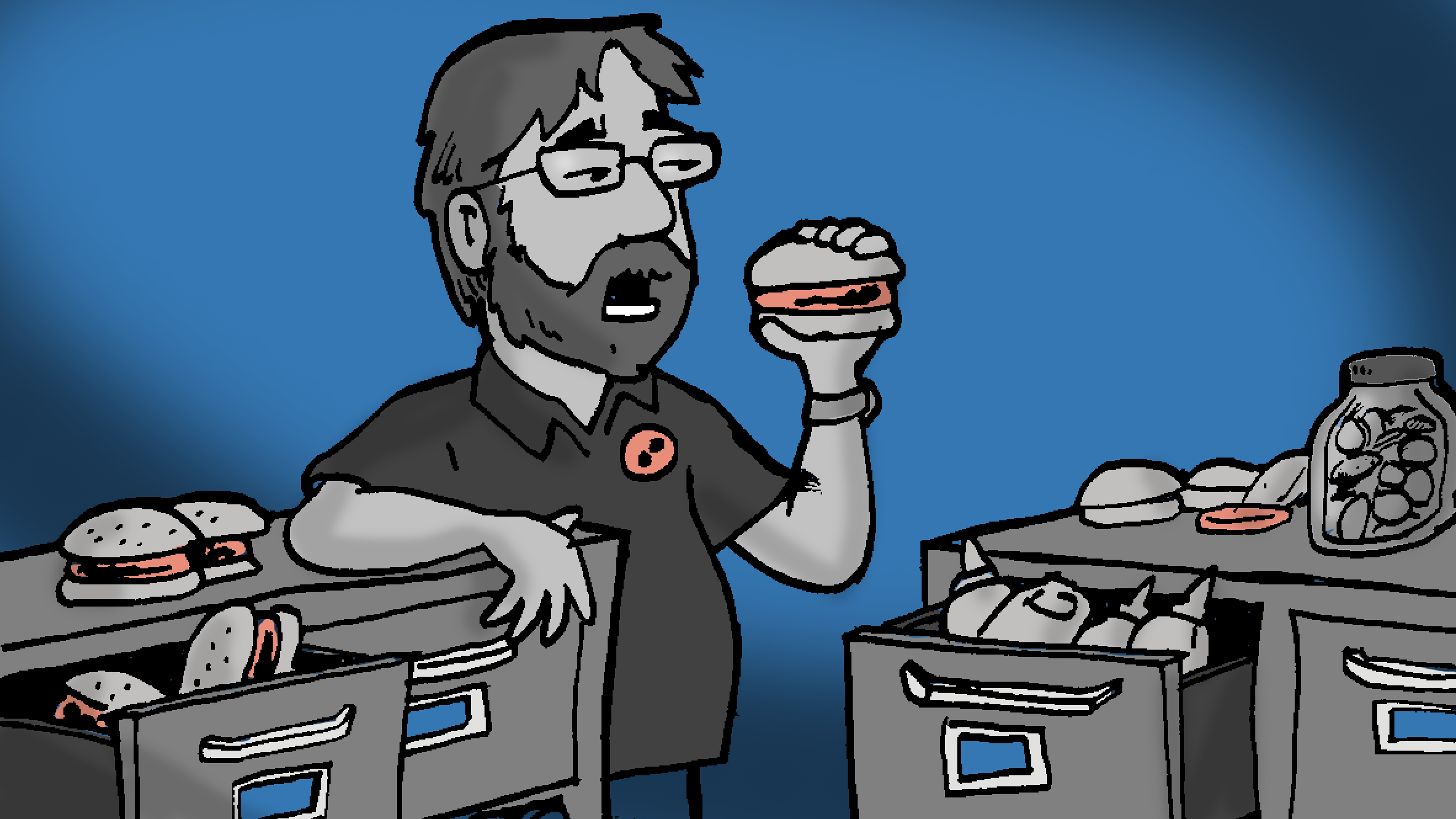
In Nexus, Harari writes that people who feel the need to ascribe clear labels to things and file them in categories are called bureaucrats. The word bureaucracy originates from the French bureau, meaning a chest of drawers—specifically the type used for filing. That origin speaks volumes: bureaucracy, at its core, is about putting things into drawers.
The frustrating aspect of a bureaucracy is that not everything fits nicely into a set of labeled drawers. Anyone who has done any filing knows that some items only vaguely qualify for a particular category, and that the most interesting items often end up in the miscellaneous drawer. “Bureaucracy,” Harari writes, “favors simplicity—even if it means distortion.” Sometimes order comes at the expense of truth.
When my friends and I set out to find Central Florida’s best burger, we didn’t intend for it to be an exercise in bureaucracy. Bureaucracy itself seems somehow antithetical to the burger experience.
Back at Eden Bar, on a warm afternoon, in the company of my wife, under the canopy of an ancient oak, being mindful of my cholesterol, I ordered a black bean burger with white American cheese. It came on a soft bun with a side of crispy, well-seasoned fries. Between bites, I sipped on a tall golden glass of beer, an IPA if you must know, and although no cows had been sacrificed for my lunch, I enjoyed a quintessential burger experience—even if it didn’t conform to any intersubjective conventions.