Good Enough to Play
Building a practical tolerance for imperfection.
My wife gave me a guitar for my 30th birthday, a department store special she bought with a 20% off coupon. I had wanted a guitar for a while, but as a young father, working hard and doing my part to keep our family afloat, I never afforded myself the indulgence—which made it a perfect gift.
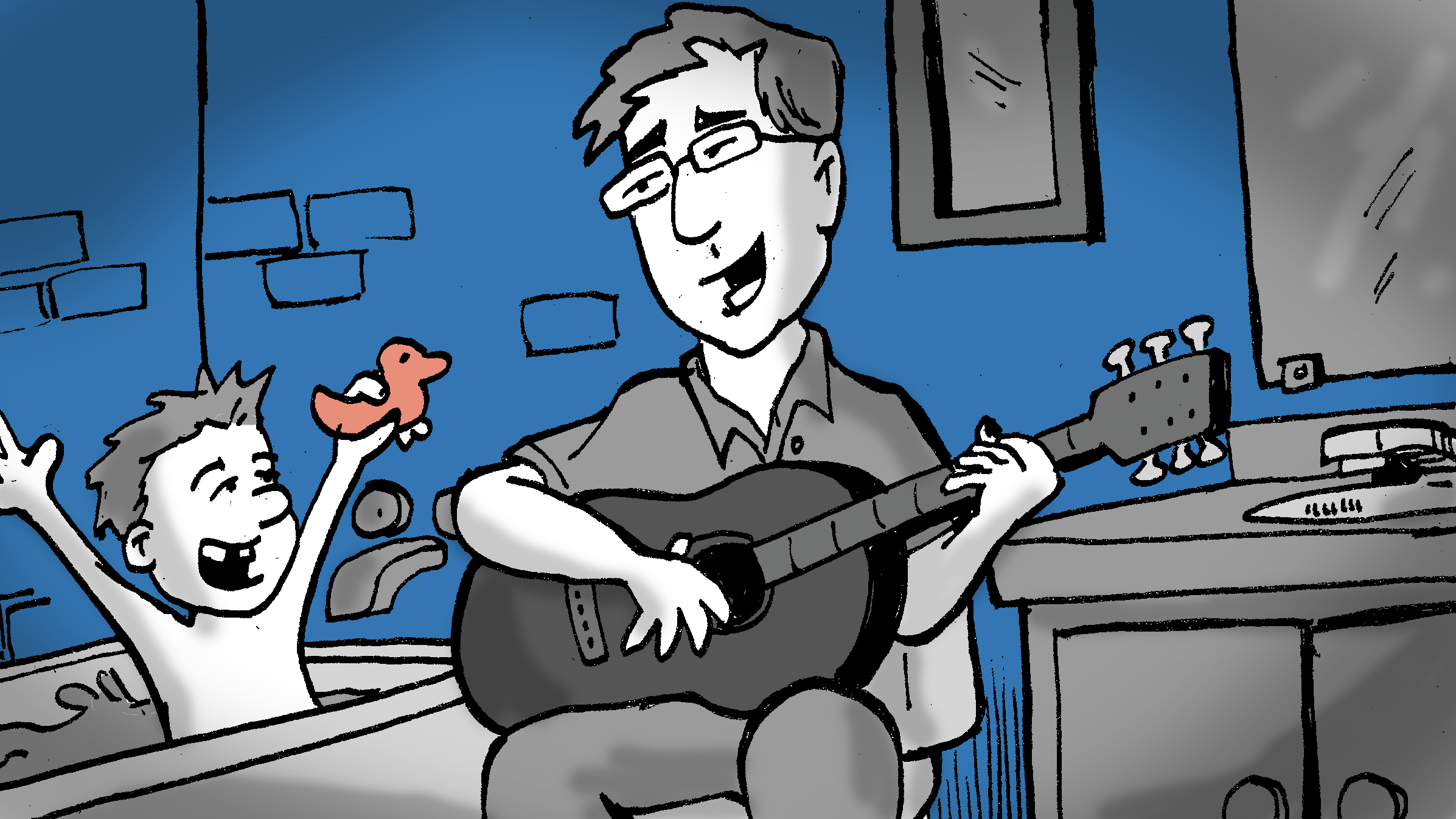
I taught myself to play, building up calluses while twisting my fingers to make common chords. I often practiced during bathtime. While my kids splashed in the tub, I sat on the toilet seat and picked and strummed and sang. Over several months, I learned a dozen chords and about that many songs.
During one bathtime jam, I caught the spirit, and while furiously strumming, I broke a string—the little E. The thin guy down at the bottom. I had no idea how to string a guitar, so after two weeks of tuneless tub times, I hired the tech at a music shop. I learned that the twisty knobs on the head of the guitar are called tuning machines. I watched the tech work so I could learn, but his practiced hands moved too fast.
Months passed. I played constantly, careful not to bust another string. Eventually, keeping the guitar in tune became a challenge. A friend who also played told me I needed to change the strings. To count myself as a guitar player, I knew I had to learn to replace the strings by myself.
Restringing a guitar is tough. After my first attempt, the head of the guitar was a nest of tangled wire, and I broke the little E string by overtightening it. I bought another string and broke that one, too. Tuneless tub times returned.
A fellow named John from my office building played guitar. While I could eke out a handful of songs, John played live gigs with a cover band. If I brought my guitar and a set of strings to the office, he said he would show me how to restring it. The next day I came prepared, and at 5 o’clock, John appeared at my door carrying a guitar case and a little tool bag—like a guitar doctor making a house call.
John uncased his guitar, a beautiful Martin. He’d demonstrate on his Martin, and I’d follow along on my department store special. Restringing a guitar, he said, is something you have to learn with your fingers.
He had a tool for removing the bridge pins that anchored the strings. A new string fits into a groove along the shaft of the pin, which he gently tapped back into place. He stretched the string along the neck, held it to the nut with his thumb, pulled it past the first machine peg, and cut it at the second. He angled the hole in the peg, bent the tip of the string, threaded it, and slowly tightened the machine keys while keeping pressure on the string so it would coil gently down the peg.
I fumbled along with my guitar. It takes finesse to coil the strings cleanly, and I botched the job, but he told me not to worry and assured me I’d get the hang of it as we worked through the next five strings. We tackled the A, the D, and the G. At B, I got the feel and produced a nice coil.
After we strung the little E, the time came to tune the strings. We started with the big E and worked our way down, twisting the machines, tuning each string, one at a time. After I tuned the little E without breaking it, John said, “I’ll bet you think the guitar is in tune now, don’t you?”
I did.
John explained that each time we tensioned a string, it affected the load on the neck, which affected all the other strings. When I tested the big E against the tuner, it had gone flat. I twisted the machine key to tighten it back in tune. I repeated the process for all the others. When I reached the bottom, I strummed an open chord. It sounded correct, but I realized that tuning the strings on the second pass still affected the other strings, but because I made finer adjustments, I also made a smaller impact on the other strings.
By tuning a guitar one string at a time, we could never get completely, truly in tune—but we got pretty damn close. We reached an acceptable tolerance for our purposes. Our guitars might not have been perfectly in tune, but they were practically in tune.
I’ve learned there are lots of technical limitations on how perfectly we can tune a guitar. At a certain point, the machines don’t have the sensitivity to make adjustments fine enough to achieve a technically perfect tuning—a physical barrier determined by the tuning resolution of the machines. My clumsy, fat fingers also impacted my capacity for fine-tuning, reducing the granularity of my adjustments. All of that is fine because my ears can only detect a pitch within a certain range, so a perfectly tuned guitar would be wasted on me. Also, my poor ability to fret the strings cleanly enough to produce a pure chord makes fine-tuning moot.
Once tuned, guitars immediately begin to become untuned. Simply playing a guitar takes it out of tune. Taking a guitar in and out of a case knocks it out of tune. A guitar at rest goes out of tune as temperature variations compress and expand the component materials. Sometimes my dog walks near the stand in the living room, and her wagging tail hammers the strings, nudging them out of tune. Just thinking about playing the guitar, I believe, can send it out of tune.
Playing guitar means constantly tuning the guitar. Each time you pick up a guitar, you know it is less in tune than when you last set it down. If you watch someone who plays, when they encounter a guitar that has been silent for a while, you’ll see them strum a quick chord progression to detect how out of whack the instrument is. I instinctively play a quick C-G-C progression. I can’t tune a guitar by ear, so if I’m just fooling around, to save myself the trouble of pulling out my tuning app, I allow a generous tolerance for how well-tuned the guitar must be before I play. If I required a perfectly tuned guitar, I’d never play.
Not that I play much anymore. I have other priorities and creative outlets, so my guitar sits silent for weeks and months. Now and again, on the rare occasion I find myself alone in the house—when my wife is with a friend, my daughter at college, my son at football practice—I’ll pick up the guitar, strike a quick C-G-C, and although the instrument has fallen distressingly out of tune, it explodes into a song that transports me through space and time to an era when I would sit on the toilet seat and hack away at songs that reverberated off bathroom tile as my babies splashed and played and sang.